Pages

Check out our listings and more at www.gelderman.ca
Showing posts with label BC Real Estate News. Show all posts

Friday, August 5, 2016

BC's new 15% non-resident Property Transfer Tax another political fail

BC Government Stumbles Again with New Tax

The new residential Property Transfer Tax, which slaps an additional 15% fee on non-resident buyers, is yet another  misstep by the Clark administration. The idea is for the tax to limit foreign investment. In reality, it will fail to have any significant impact on foreign demand, meaning it can do nothing to improve affordability, but will instead end up hurting the innocent public in the process. This lame-duck legislation, which is intended only to affect Metro Vancouver real estate, once again demonstrates the provincial government’s inability (or unwillingness) to address the real root causes of BC’s housing affordability crisis, and their readiness to use the situation to enrich their own bottom line instead. I truly believe that this new tax is nothing more than a ruse to appease public concern over the problem of affordable housing, and to garner popularity prior to the next provincial election. Let me explain.

Recently, the provincial government released its own data showing that ONLY 5% of the residential property transactions in Metro Vancouver were purchased by foreign nationals, meaning that, by the government’s own admission, 95% of transactions would not be affected by the new tax. It’s important to realize, that 5% represents the full number of foreign national purchases counted prior to there being any effort to avoid the tax. It is very easy –– and perfectly legal –– for a non-resident purchaser to conduct a transaction under the name of a family member or business with resident status; it’s also plausible to assume some of that 5% will still make purchases despite the tax, therefore, post-implementation, we can expect the percentage of affected transactions to drop even lower than 5%.

The new tax is also supposed to help reduce Vancouver’s vacancy rates, another scapegoat touted as a significant contributor to skyrocketing prices. Yet, when we look at the recently released data, Vancouver’s vacancy rate of 7.2% is completely in-line with the overall average of Canadian metropolises which stands at 7%. Not only is there nothing unusual about Vancouver, but the vacancy of the city’s single-family homes, duplexes, and row houses specifically have remained static since 2002. The facts do not bear out the hype!

The government’s new measures are intended to make it look like they’re taking action to protect the public and address affordability, yet it’s nothing but smoke and mirrors. Take for example the numerous times over the last 10 years that REALTORS® have lobbied the government to make changes to the the Real Estate Services and Marketing Act in the interest of better protecting the public. Specifically, we asked for the power to charge stiffer fines and penalties for those agents contravening the act. Our requests were ignored; the government was apparently unconcerned. Now, when it’s politically advantageous for them to respond, suddenly they’re interested in doing something.

Another serious issue that causes me to question the government’s motives is the fact that when they rolled out this tax they failed to exempt current transactions on the books that have been confirmed (making them legally binding) but have not yet closed. I shudder to think of all the non-residents who did their due diligence and were approved for the purchase of their homes in Metro Vancouver according to all of the information available at the time, only to be slapped with a 15% tax that they didn’t budget for. Some serious questions have been raised about whether it is even ethical under NAFTA (North American Free Trade Agreement) and Canada’s Charter of Rights and Freedoms.

But this is not just tragic and enormously inconvenient for the non-resident Buyer. If they are put in a position to have to renege on their purchase due to a lack of necessary ready funds, causing them to lose their deposit in addition to their deal, it will also cause a disastrous chain of events for all contingent transactions. And most property sales are connected to contingent transactions. The effects could ripple out beyond the borders of Metro Vancouver and will end up punishing many innocent, law-abiding, tax paying citizens who did their legal due diligence and who may stand to face losing everything!! The effects are already being felt.

Writing in a provision to exempt current firm and binding contracts is a simple step the Clark administration could easily have taken, but they didn’t. This incredible oversight goes to show that they are not primarily motivated by a desire to protect the public.

I want to emphasize again, like I did in my critique of the similarly misguided response to the IAG report, that the two most important things that drive prices are SUPPLY and DEMAND. All that these new taxes will do is potentially curb minimal demand-- we’re talking about fewer than 5% of all residential transactions and only in the Metro Vancouver area. The law will not deter those non-resident purchasers who can take the legal steps to avoid the tax or those who can afford it. More importantly, the government has completely failed to address the lack of supply.

Nothing has been done to address the imbalance between our suppressed supply and our ever-increasing demand. Between 3,000-4,000 people move into the province every month and we simply don’t have places for them to go. There are a number of measures that could ease this problem in a meaningful way. For example, the government could release some land out of the ALR (Agricultural Land Reserve). Areas like Abbotsford, Chilliwack, and Langley are greatly restricted in the areas that they can develop because of the enormous tracts of land protected by the ALR. Also, they should create measures to fast-track construction permit approvals. Municipal offices are overwhelmed with permit applications and currently there aren’t any set deadlines for processing, meaning that they can take a prohibitively long time to process. There are plenty of other options the government could easily implement that could ease the pressure on prices, such as providing development incentives, improving transit to encourage the population to spread out, and increasing the density of existing residential areas. All of these measures would address the supply shortage, which is the central factor in our housing cost inflation. But no, all the Clark administration is capable of is tax, tax, tax! Can you see why I’m cynical?

Do you know anyone tragically impacted by these new measures? Tell us in the comments below!

Wednesday, June 25, 2014

Buyers Camp out for Three Days for Brentwood Condos

From the Vancouver Sun:


Despite recent predictions about the inevitable burst of the Greater Vancouver real-estate bubble, buyers last week were camped out three days before Saturday’s presale of a new Burnaby mega-project.

“We expected that people would be camped out on Friday — we weren’t expecting them on the Wednesday before,” says Macartney Greenfield, Rennie Marketing System’s project manager. 

Brentwood is a 28-acre master-planned community that combines shopping in 350 stores, dining, entertainment and residences in an open-air high street and one-acre public plaza connected to transit.

Of 288 units available in the first tower of the Brentwood development at Lougheed and Willingdon — with occupancy slated for winter 2017 — all were sold on Saturday. Three penthouse units were not yet released, but likely will be in the fall when units for a second 63-storey tower will be made available.

“I think it has a lot to do with the revitalization of Brentwood as a neighbourhood,” says Greenfield. One-bedroom units were offered at $299,000, two-bedrooms at $355,000, and a handful of three-bedroom units were sold starting at $928,000. The condo units start on the 33rd floor, with rental units below.

“The buyers have lived in this neighbourhood,” says Greenfield. “We definitely saw a lot of people buying for their children, and some are just downsizing. There was a lot of local interest.”

Friday, June 13, 2014

Strongest May for Home Sales since 2007

BCREA - Vancouver, BC 

The British Columbia Real Estate Association (BCREA) reports that a total of 8,729 residential sales were recorded by the Multiple Listing Service® (MLS®) in May, up 13.9 per cent from May 2013. Total sales dollar volume was $4.9 billion, an increase of 20.6 per cent compared to a year ago. The average MLS® residential price in the province rose to $565,233, up 5.8 per cent from the same month last year.


“Consumer demand was noticeably stronger last month, with unit sales posting their highest level for the month of May since 2007,” said Cameron Muir, BCREA Chief Economist. “Rock bottom mortgage rates are inducing many would-be home buyers to enter the market this spring.”

“With most BC markets now in balanced conditions, home prices are up in nine of 11 board areas,” added Muir.

Wednesday, June 11, 2014

BCREA June 2014 Mortgage Rate Forecast

BCREA has release their June 2014 Mortgage Rate Forecast:
To see the full report click here.


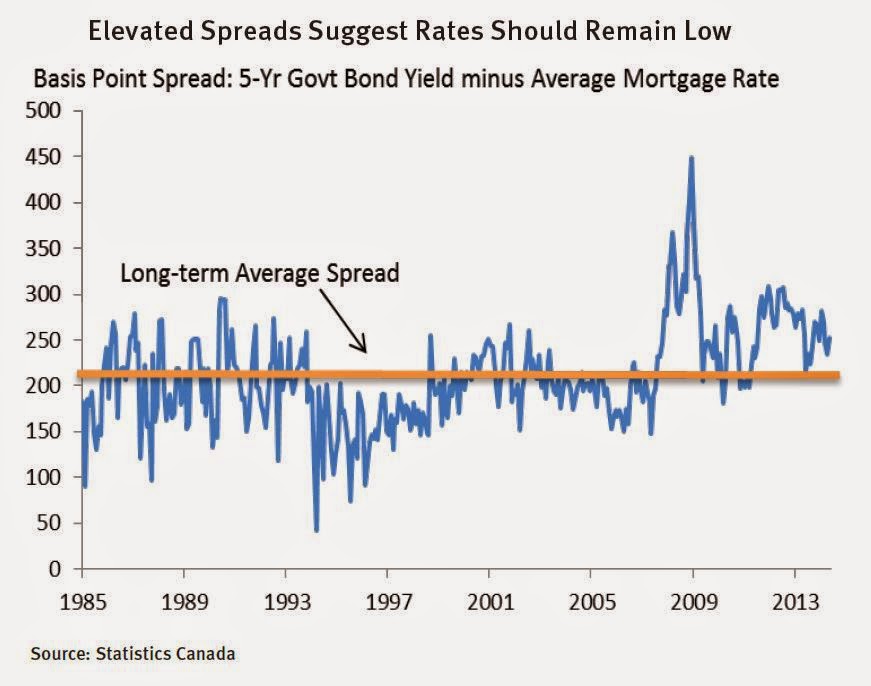
Disappointing first quarter economic growth both in Canada and in the United States, where the economy actually contracted to start the year, are helping to maintain low bond yields in both countries. In particular, yields on five-year Government of Canada bonds, the key benchmark for pricing mortgages, remains approximately 30 to 40 basis points lower than at the start of the year. As the economy improves and the spring home-buying season comes to a close, we expect that mortgage rates will be pulled higher. However, the current spread between the five-year posted rate and the yield on five-year Government of Canada bonds remains elevated. This suggests that a rish in bond yields would exert only modest pressure on mortgage rates.
Our forecast is for the five-year fixed rate to retrace above 5 per cent in the third and fourth quarter, ending the year at 5.14 per cent. The 1-year mortgage rate is expected to remain close to its current level of 3.14 per cent for the remainder of the year. 


Mortgage Rate Outlook

Low long-term interest rates and heightened competition in the mortgage market pushed both posted and discounted mortgage rates to record lows during the second quarter. The posted five-year fixed rate reached a historical low of 4.79 per cent in May and many lenders have advertised sub-3 per cent five-year fixed rates as well as steeply discounted variable rates. 

Wednesday, May 14, 2014

Record Low Mortgage Rates Push Home Sales Higher


The British Columbia Real Estate Association (BCREA) reports that a total of 7,730 residential sales were recorded by the Multiple Listing Service® (MLS®) in April, up 12 per cent from April 2013. Total sales dollar volume was $4.3 billion, an increase of 19 per cent compared to a year ago. The average MLS® residential price in the province rose to $561,613, up 6.3 per cent from the same month last year. 
"BC home sales trended higher in April as the typically robust spring market unfolds,” said Cameron Muir, BCREA Chief Economist. “Rising consumer demand coupled with fewer homes for sale has most BC housing markets now exhibiting balanced conditions, where neither buyers nor sellers have any particular advantage."
"Housing affordability improved last month as intensifying completion for new business by financial institutions pushed the posted five-year fixed mortgage rate to a record low of 4.79 per cent” added Muir.
During the first four months of the year, BC residential sales dollar volume was nearly 28 per cent to $13.9 billion, compared to the same period last year. Residential unit sales were up 18 per cent to 24,165 units, while the average MLS® residential price was up 8.3 per cent at $573,965.

For more information visit the BCREA website.

Monday, May 5, 2014

Hottest spots for B.C. homebuyers: Surrey, Abbotsford, Evergreen Line communities all in high demand


Wondering where B.C.’s housing hot spots will be over the next few years?

Surrey residents are living in what experts say is the Lower Mainland’s hottest real-estate market.
Communities such as Clayton Heights, Cloverdale and Fleetwood are hot and expected to stay hot in the near future as buyers seek affordable housing near family-friendly services.
Other areas expected to see brisk demand from buyers over the next few years are Burnaby’s Brentwood, the Tri-Cities and Fraser Valley communities of Langley, Maple Ridge, Pitt Meadows and Abbotsford.
In Vancouver, urbanites who prize city living are pushing up demand in the Main Street, Outer Hastings and East Vancouver’s Cedar Cottage neighbourhoods, says Tsur Somerville, director of the University of B.C.’s Centre for Urban Economics and Real Estate.

FRASER VALLEY ON THE RISE

Homebuyers seeking affordable houses will arrive in two waves into the Fraser Valley, says Don R. Campbell, senior analyst with the Real Estate Investment Network.
Abbotsford may not seem an obvious hot-spot-to-be but Campbell says it has great potential, with ample residential, industrial and agricultural land.
“Five years from now, when people discover Abbotsford, they’ll go, ‘Why didn’t you tell me sooner’? Campbell says.
“It’s basic human nature. We all love to wait until something is right in front of us, or past us.”

Not to be overlooked is the positive price impact of the Evergreen Line on communities in Burnaby, Coquitlam, Port Moody and Port Coquitlam that are near stations to be built, he says.
Among the neighbourhoods that should see a price boost from the new SkyTrain line are Sullivan Heights, Keswick Park, Caribou, Brookmere Park, Harbour Chines, northern Chineside, Chineside, Cassin, Eagle Ridge, Harbour Village and Meadowbrook, predicts the Real Estate Investment Network.
Residents of Glen Park, Sheila Barrett Park and Dacre Park who live within 800 metres of the planned Lincoln Station in Coquitlam “can anticipate a 10 to 20 per cent premium in their values,” the network predicts.
Cameron Muir, chief economist with the B.C. Real Estate Association, says he wishes he had a dollar for each time someone asked him which areas of the Lower Mainland are under-valued.
Muir says he doesn’t have enough data to predict popularity or price acceleration.
But he does suggest watching areas such as Richmond, where immigrants, especially from Asia, will continue to buy.
“Richmond is something to keep an eye on in terms of valuation,” Muir says.
“Immigrants typically locate where other ex-pats are and that’s why you’ll likely see additional demand there.”
Campbell is all for buying homes strategically — where prices are likely to outperform the average — but advises people against buying more house than they need or will be able afford when interest rates rise.
Buyers must also accept that real-estate markets rise, fall and plateau, he says.
“A market will always clean itself up. That can be cleaning up just by plateauing.
“If you bought a place and it stayed the same value for 10 years, would you be OK with that?”

SKYTRAIN A BIG ATTRACTION

“Gentrification or new developments can change people’s perceptions in ways that make some areas ‘hotter’ than others,” Somerville says.
Homeowners near a SkyTrain station or a new stop on the Evergreen Line that is now under construction will get the best of both worlds: high demand and faster-than-average price climbs, experts say.
But the first doesn’t necessarily translate into the second in the land-constrained Lower Mainland, real-estate watchers say.
Communities where demand is high may find price increases tempered if there are relatively large chunks of undeveloped land in the area.
And areas where demand is cooler — such as Vancouver’s West Side and West Vancouver — may see faster price appreciation because they’re “built out” — you can’t squash more houses in there.
“There’s a difference between where demand will go versus where price gains will be the highest because of things such as land constraints,” says Bryan Yu, regional economist with Central 1 Credit Union.
Using land for multi-family developments also maintains an area’s affordability for buyers, Yu says. But condo price appreciation will generally be less than it is for detached properties as condos comprise an increasing share of the Lower Mainland’s housing mix, Yu says.
“Prices of ground-oriented properties in the long term are expected to rise at a stronger pace than for condominiums,” Yu says.

SURREY NO. 1

Lower Mainland communities claim five spots on the Real Estate Investment Network’s latest list of Top 10 B.C. investment towns: Surrey ranks as No. 1, followed by Maple Ridge and Pitt Meadows tied at No. 2, Abbotsford at No. 6, Chilliwack at No. 8 and Langley at No. 10.
Homebuyers seeking affordable houses will arrive in two waves into the Fraser Valley, says Don R. Campbell, senior analyst with the Real Estate Investment Network.
The first wave of demand is washing over Surrey, Maple Ridge and Pitt Meadows. Surrey alone is expected to become home to an estimated 250,000 more people over the next three decades.
Campbell calls Surrey a “beautiful market” for first- and second-time homebuyers with its mix of multi-family projects, affordable older homes, a growing city centre, rising employment and shorter commutes to Vancouver, thanks to the new Port Mann Bridge.
“We’re going to see the largest growth in housing demand in Surrey,” Campbell says.
“Companies are getting a lot more comfortable with building manufacturing plants, which will attract people to live and work in Surrey and bring more stability to the housing market.”
Neighbourhoods near Surrey’s SkyTrain stations — Scott Road, Surrey Central, Gateway and King George — should see higher-than-average price increases over the next five years, Campbell says.
Studies show that homes within 800 metres of a transit station grow in value 12 to 15 per cent faster than equivalent homes outside this zone, Campbell says.
“Conversely, if the market slows or drops, the properties in these zones drop less and at a slower rate,” Campbell says.
Kelvin Neufeld, managing broker with Sutton Premier Realty in Surrey, says Cloverdale, Fleetwood, Clayton Heights and South Surrey are trending upwards in demand and price, especially for single-family homes.
The second wave of demand is already lapping at Langley, Abbotsford and even Chilliwack.
It will intensify over the next few years as buyers take advantage of the Lower Mainland’s improved bridge and highway infrastructure to access affordable areas., Campbell says.

LOOK TO THE NORTH

Surrey may be B.C.’s hottest spot for overall real-estate activity but it’s far from the only game in town. Areas of Northern B.C., riding an energy resource boom, are also expected to post high demand for real estate.
The north accounts for three of the Real Estate Investment Network’sTop 10 B.C. investment towns. Fort St. John is No. 3, followed by Dawson Creek at No. 4 and Prince George in ninth spot.
Kelowna and Kamloops also place in the network’s Top 10 real estate picks, making half of the hottest spots outside of the Lower Mainland.
As B.C.’s oil-and-gas capital, Fort St. John is attracting people in droves because of high wages and the relative ease of finding work, the network says.
“The major demand for housing in the region is currently rental product but as the labour market in the region matures, we expect this demand to shift to single-family, owner-occupied housing,” the network says. “The city’s current fundamentals echo Fort McMurray, Alberta, 10-15 years ago.”
Kitimat’s housing market has been red hot as buyers snap up houses in anticipation of LNG projects becoming a reality. The average house price in Kitimat soared 70 per cent in March from the same month a year ago, the B.C. Real Estate Association reports.
But Don R. Campbell, senior analyst with the Real Estate Investment Network, says housebuyers should exercise caution if they buy a property solely on the basis of proposed LNG plants.
“From a strategic buyer’s point of view, I don’t want to see announcements or proposals. I want to wait until I see shovels in the ground and then I would buy a property,” Campbell says. If you don’t wait, you’re putting yourself at risk.”
Cameron Muir, chief economist with the B.C. Real Estate Association, says markets such as the Okanagan have been in the doldrums for the past few years but are showing signs of renewed strength.
“Consumers sense that a kind of bottom to the (Okanagan) market has been reached,” Muir says. “Strength in the Alberta economy and Alberta housing market is helping to drive housing investment back into British Columbia. That’s helping the Okanagan. The Kootenays will benefit as well.”
But people kicking the tires of recreational property in the Okanagan and on Vancouver Island should not look forward to big price jumps, says Yu.
“Recreational markets in the southern Interior and on the Island are forecast to observe sub-one-per-cent growth through 2015,” Yu says. “Larger urban markets like Victoria and Kelowna will likely fare only slightly better.”

REAL ESTATE FACTS

The average price for existing homes in B.C. will grow by 0.9 per cent this year to $542,500 and by 0.8 per cent next year to $547,100, according to Canada Mortgage and Housing Corp.
Existing home sales across the province should reach 76,000 this year, up 4.2 per cent from 72,936 last year. Sales should grow by 1.7 per cent next year to 77,300, according to CMHC.
The average MLS price for ­Metro Vancouver is expected to rise by 1.1 per cent this year to $776,000, and by 0.9 per cent next year to $782,700, CMHC says.
The number of resales in the area is expected to rise by 3.5 per cent this year and slip five per cent next.
Central 1 Credit Union predicts the median resale price for multi-family dwellings in Metro Vancouver will rise about one per cent this year, and two to three per cent a year in 2015-2016. The median price for detached homes in the area will rise two per cent this year and about four per cent in 2015-2016, Central 1 forecasts.
Housing starts in B.C. will be about 27,300 units this year and will exceed 30,000 units from 2015 onward, Central 1 says.

From the Vancouver Province

Wednesday, April 16, 2014

Low Mortgage Rates a Key Driver in Spring Market

Vancouver, BC – April 15, 2014. 

gelderman.ca real estate team

The British Columbia Real Estate Association (BCREA) reports that a total of 6,661 residential sales were recorded by the Multiple Listing Service® (MLS®) in March, up 16.8 per cent from March 2013. 
Total sales dollar volume was $3.7 billion, an increase of 21.5 per cent compared to a year ago. The average MLS® residential price in the province rose to $562,316, up 4 per cent from the same period last year. 
“While home sales are up from a year ago, consumer demand in the province has largely been treading water over the first quarter,” said Cameron Muir, BCREA Chief Economist. “However, fewer homes for sale means that most BC markets are moving into balanced conditions, which signals no particular advantage to either home buyers or sellers.”
“Low mortgage interest rates are a key driver in the market, this spring,” added Muir. “It’s unlikely that mortgage rates will be at their current low level a year from now.”
During the first quarter, BC residential sales dollar volume was up 32.4 per cent to $9.5 billion, compared to the same period last year. Residential unit sales were up 21.1 per cent to 16,435 units, while the average MLS® residential price was up 9.3 per cent at $579,775.

Monday, April 7, 2014

Buyers were on the Hunt for Houses in March

From the Vancouver Sun: 
Sales of detached homes outpaced condos and townhomes throughout the region
gelderman.ca real estate fraser valley homes for sale


Buyers favoured houses in the suburbs and condos in pricier urban communities in March, according to sales results released Wednesday for the Lower Mainland’s main property markets.
March sales showed an improvement from a year ago, but transactions continued to trend below their 10-year average, according to the reports.
“There has been a consistent balance between homeseller supply and homebuyer demand in our marketplace over the last year,” said Ray Harris, the newly installed president of the Real Estate Board of Greater Vancouver, in a news release.

Wednesday, March 26, 2014

Helping your Child buy their First Home

From the Vancouver Sun:
The 'bank of mom and dad': Advice on helping children with that first home purchase

gelderman.ca real estate blog first time home buyer house for sale
BMO Bank of Montreal found that up to 40 per cent of their first-time buyers expect some family help to get on the property ladder. Vancouver Sun reporter Derrick Penner sought some expert advice on how parents can approach the situation.
Q: How can I help my child buy her first home?

A: It can be as simple as co-signing on the mortgage to help a child who has saved some money for a down payment, but still can’t meet all the qualification requirements, said Richard Bell, a real estate lawyer with Bell Alliance Lawyers and Notaries Public in Vancouver. Or, a parent can offer a gift of cash.

Q: How do I go about gifting money to my daughter to help her make up the down payment on her first home?

Monday, March 24, 2014

CREA Updates and Extends Resale Housing Forecast

From CREA.ca :: The Canadian Real Estate Association (CREA) has updated its forecast for home sales activity via the Multiple Listing Service® (MLS®) Systems of Canadian real estate Boards and Associations in 2014, and extended the outlook to 2015.


Gelderman.ca real estate team blog, real estate market

National resale housing activity has started 2014 at lower levels, compared to previous years. This in part reflects payback for stronger levels of activity recorded last summer and fall when buyers with pre-approved mortgage financing advanced home purchases before their lower pre-approved rates expired. It also likely reflects the deferral of some activity due to what has been an exceptionally tough winter in many parts of the country.

Tuesday, March 18, 2014

Housing Market Update - March 2014


Housing Market Update (March 2014)
Watch BCREA Chief Economist Cameron Muir discuss the February 2014 statistics

Wednesday, February 19, 2014

Good news for First Time Home Buyers

gelderman.ca real estate blog, first time home buyers
The B.C. Provincial Government announced its provincial budget for 2014 - which included some good news for first time home buyers in B.C. The B.C. First Time Home Buyers Program allows B.C. residents to reduce or eliminate the property transfer tax paid when purchasing their first home. The B.C. government has increased the threshold for this program to $475,000 from $425,000 - effective February 19, 2014. This means that any home purchased by a first time home buyer for a fair market value of $475,000 or less is exempt from paying any property transfer tax - a savings up to $7500. 

For more information on the First Time Home Buyers Program, visit the website here. 

Tuesday, February 11, 2014

Vancouver sales up 30% over last January

gelderman.ca real estate blog real estate for sale sold remax
The Real Estate Board of Greater Vancouver reported a 30.3% increase in sales in January 2014 over January 2013. Sales through the multiple listing service totalled 1760 for the month, a big jump from the 1351 made in January last year. 
The board also noted that the January sales for 2014 were 7.2% higher than the 10 year average for January. 
“The Greater Vancouver housing market has been a balanced market for nearly a year,” board president Sandra Wyant said in a statement.
“This has meant steady home sale and listing activity, accompanied by stable home prices.”

Read more at the Vancouver Sun here.

Monday, January 13, 2014

BC Home Sales show steady growth for 2013

BCREA - A report released by the BCREA today shows a bounce back in home sales in B.C. in 2013. Residential sales increased by 7.8% from 2012, while the annual residential home price in the province was up 4.4% from 2012. Total sales dollar volume was $39.2 billion, an 
Gelderman.ca real estate team, BC MLS residential home salesincrease of 12.6% compared to 2012.
“After declining nearly 12 per cent in 2012, home sales posted steady growth through last year,” said Cameron Muir, BCREA Chief Economist. “Greater Vancouver, Kamloops and Okanagan Mainline board posted the most significant changes, with home sales rising between 12.5 and 14 per cent. Stronger consumer demand combined with fewer 
homes listed for sale improved market conditions in most regions last year.” 

Monday, December 16, 2013

Housing Forecast for 2014

Fraser valley real estate market 2014The Canadian Real Estate Association (CREA) has released its housing sales forecast for Canada in 2014.
For 2013, the market remained stable - for the sixth year in a row, sales will be around 450,000 units for the year.
In 2014, this is expected to increase to 475,000 units, an increase of 3.7%. British Columbia is predicted to have the strongest increase in 2014, with a projected sales increase of 8.4%. The rest of the country is expected to have gains in the 2 to 4 percent range.
The average national house price is also expected to rise in 2014, by 2.5% to 391,100. Alberta is forecast to have the biggest rise in average price, with an increase of 3.4%.
Read the entire report online here.

Thinking of selling your home in 2014? Contact us for a free Comparative Market Analysis of your home!

Thursday, December 5, 2013

Response to a Home Inspector


Gelderman.ca real estate team blog - real estate home inspectionhttp://www.canadianrealestatemagazine.ca/news/item/1822-whistle-blower-points-to-home-inspection-shortfalls

On December 4th, Canadian Real Estate Magazine posted the above article about home inspections. It features an interview with a home inspector who has recently published a book on this issues with the home inspection profession - and attempts to blame Realtors for the problems.
 
This home inspector needs to give his head a shake. Here are the problems with his article:

1) Realtors(r) do not dictate how inspections result, and don't choose inspectors based on "blown sales." First off, Realtors(r) do not choose inspectors: buyers do.
 
Agents may recommend a few inspectors, but they may never recommend just one. And just as the Buyer freely chooses their Realtor(r), the buyer freely chooses their inspector.

Friday, November 15, 2013

BC Homes sales - Strongest October in Four Years

Gelderman.ca Real Estate team - BC Real Estate Residential MLS stats
 
Vancouver, BC – November 15, 2013: The British Columbia Real Estate Association (BCREA) reports that a total of 6,673 residential sales were recorded by the Multiple Listing Service® (MLS®) in BC during October, up 26.5% from October 2012. Total sales dollar volume was 34.5% higher than a year ago at $3.6 billion. The average MLS® residential price in the province was $540,432, up 6.3% from October 2012. 

Thursday, November 14, 2013

Abusive Condo owner ordered to sell


Gelderman.ca real estate team blog - surrey real estate condoThe B.C. Court of Appeal handed down a decision Tuesday ordering a disruptive condo owner to sell after years of legal disputes. The condo owner and her son had more than 1,100 complaints going back to 2006 - including behaviour so abusive their neighbours started wearing cameras to video the conflicts. The court decided the age old "a man's home is his castle" does not apply in cases like this:  “the right of quiet enjoyment in collective living” trumps property rights. Check out the entire article at http://www.vancouversun.com/technology/Mulgrew+Abusive+condo+owner+ordered+sell/9157577/story.html

Tuesday, November 12, 2013

Housing Market Rebound to Extend into 2014


Gelderman.ca Real Estate team blog - MLS BC forecastThe British Columbia Real Estate Association (BCREA) released its 2013 Fourth Quarter Housing Forecast today.

BC Multiple Listing Service® (MLS®) residential sales are forecast to increase 6 per cent to 71,700 units this year, before increasing a further 6.3 per cent to 76,200 units in 2014.

“Consumer demand has bounced back after waning for most of 2012,” said Cameron Muir, BCREA Chief Economist. “With higher interest rates on the horizon, many potential homebuyers are choosing to lock in a mortgage sooner rather than later. However, rather than signaling a return to frenetic home buying activity and accelerating markets, consumer demand is simply transitioning back to its long term average.”
The average MLS® residential price forecast for the province has been revised upward from a 3.3 to a 4.3 per cent increase to $537,100 this year, as a result of stronger than expected market conditions in Vancouver. The average MLS® residential price in BC is forecast to increase a further 2.1 per cent to 548,200 in 2014.

See more information at : http://www.bcrea.bc.ca/news-and-publications/news-room/news-releases/housing-forecast-news-release